
Late afternoon in Scottsdale has a way of revealing paintings honestly. A canvas that looked calm under gallery spots can suddenly show its true scale against a warm wall, and the frame’s edge, the weave of the support, even the shadow it throws can change the whole room. In a bright living space with pale stone, glass, and low furniture, a work either settles in cleanly or starts asking for more distance, more light, or a different wall altogether.
This guide treats collecting as a series of buying judgments, not a mood. Before any price makes the decision for you, the useful questions are concrete: who handled the work before it reached you, what condition issues are present or hidden, what medium and support you are actually buying, how the dimensions relate to the wall and the furniture beneath it, whether the framing is appropriate, and whether the piece reads as authentic in hand and in context. That matters in Scottsdale because homes here often ask art to carry presence across open plans, deep sightlines, and strong daylight, which means fit is part of value, not an afterthought.
If you have been following the earlier notes, the next sections narrow that same lens into what to verify, compare, and measure before a work leaves the gallery or studio.
Table of Contents
- Evidence and paper trail: what to verify first
- Condition, medium, and conservation implications
- Scale, placement, and how the work lives in the room
- A 90-second checklist before you buy
- Authenticity, comparison, and when the story outruns the object
- How to use Scottsdale as context without outsourcing your judgment
Evidence and paper trail: what to verify first
The first thing worth asking for is not a story, but proof that can survive a second look. A serious offer should come with an invoice or bill of sale, the artist’s name as it appears on the work, title if there is one, date, medium, support, and dimensions; if the piece has exhibition history or publication history, that should be stated plainly rather than implied. When the paper is thin, the decision changes fast: you are no longer comparing an identified work against comparable examples, you are weighing a claim that may be difficult to substantiate later.
For work by Tony Green, a collector should also ask how the piece is documented within the studio record and whether the details on the surface match the details on paper. A photograph of the front and back, a close view of signature or inscriptions, and a note on any prior framing, restoration, or studio handling can settle basic questions before they become expensive ones. If you want to understand the artist’s method and background before asking for that file, the About page gives a useful frame; if you are comparing available work by medium or scale, the Shop page helps anchor the conversation in actual objects rather than descriptions.
Thin provenance does not automatically disqualify a work, but it lowers confidence in every other claim attached to it. A piece with a clean chain of ownership, dated documentation, and consistent measurements is easier to value, insure, and resell; a piece that arrives with only a verbal account asks the buyer to absorb more risk than the price usually admits. In practical terms, ask: who owned it before, when did the work change hands, and can those facts be supported by a receipt, gallery record, exhibition label, or conservation note? If the answer is vague, the offer should be treated as provisional until the paper catches up.
That same discipline helps when a work is being considered for a specific space. A custom commission may be the cleaner route when the story is strong but the available proof or proportions are not yet aligned, and the Commission page is the place to discuss what can be made to measure rather than what must be defended after the fact.
Pro tip: Verify the paper trail before you let the story set the price.
- Ask for invoice, certificate, or studio documentation.
- Write down what is missing before you compare alternatives.
- Use the next section for materials and condition, not as a repeat of the proof check.
Condition, medium, and conservation implications
The paper trail may settle who made the work, but the surface tells you how the work has lived. In Scottsdale, where strong light and dry air can make a room look ideal until a piece starts to age in it, condition is not an abstract category; it is the difference between a painting that can be placed confidently and one that will need immediate intervention. Look closely at the support, the paint layer, and any varnish. On canvas, ask whether there is slack, cupping, prior patching, or an old relining. On panel, check for warping, cracks at the joins, and edge wear. If the work is on paper, note mat stains, foxing, and whether the framing has ever been opened. Those details should match the object’s date, medium, and the seller’s description.
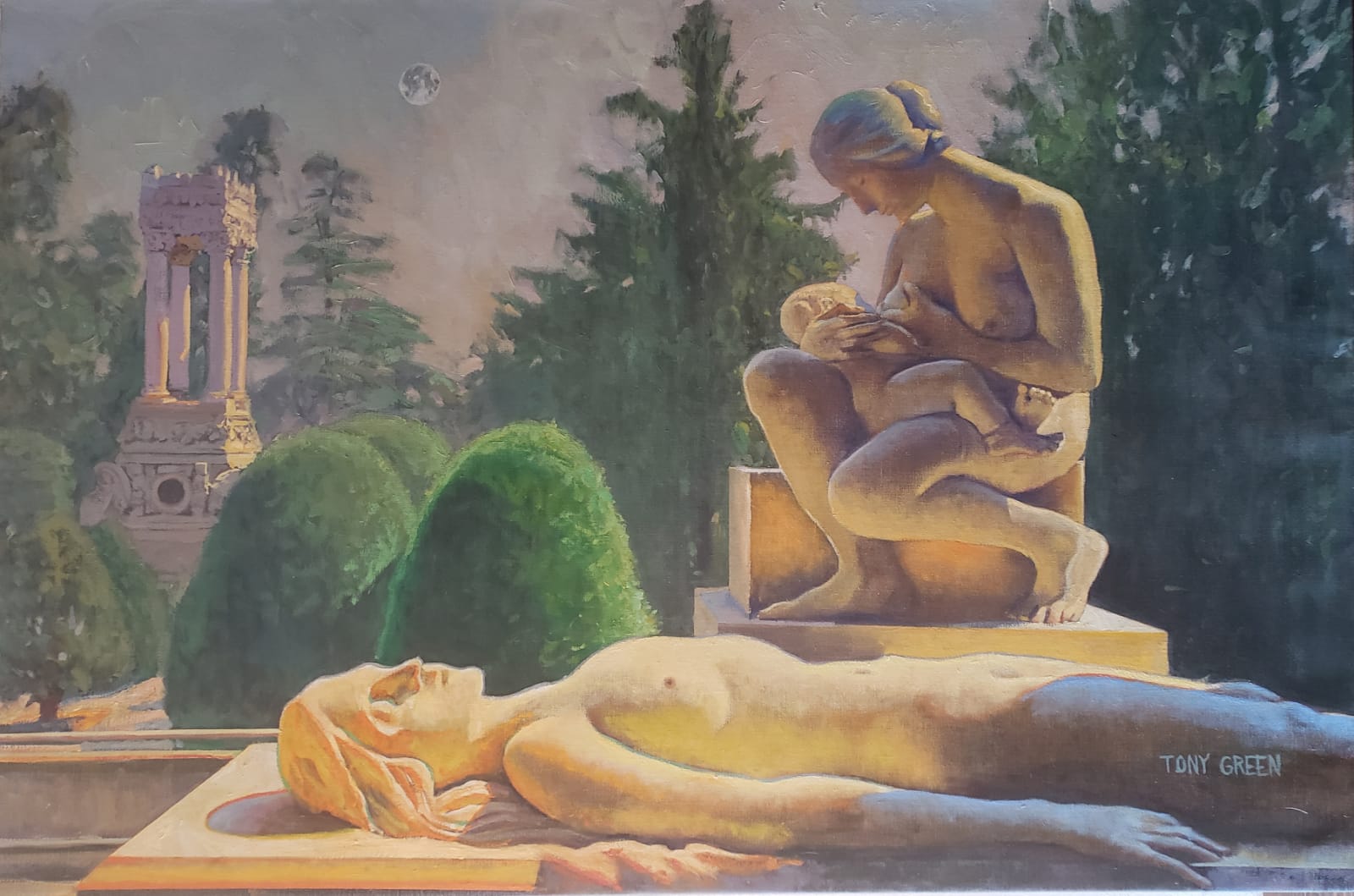
Medium changes the conversation about care and value. A classical oil painting by Tony Green, for example, will behave differently from a work in mixed media or on paper, and the buyer should ask what layer is doing the visual work: oil glazes, tempera passages, gilding, or graphite underdrawing. That answer matters because each material ages differently and asks for different handling, glazing, and lighting. If the piece comes with conservation treatment, ask for the conservator’s report and the date of intervention; if not, ask whether the surface has been cleaned, revarnished, or inpainted. A seller who can name the material build-up precisely usually knows the object well enough to price it honestly, alongside the evidence already reviewed.
Before payment, the useful questions are concrete: “Has this work been restored, and if so, by whom?” “What is the exact support size without frame?” “Are there any losses, retouching, or replaced elements?” “Can I see the back, the edges, and the hanging hardware?” If you are comparing pieces, line up the dimensions, medium, and condition notes side by side; a slightly smaller work in better condition may be the stronger buy.
Scale, placement, and how the work lives in the room
Once the facts are on the table, the real question is simpler and more demanding: can the piece live comfortably where you plan to see it every day? A work that looks commanding in a gallery can feel cramped above a low sofa, while something modest on paper may become the most exacting object in a quiet hallway. Measure the wall, the furniture beneath it, and the viewing distance before you buy; a 36-inch image over an 84-inch sofa reads very differently from the same image above a narrow console. In Scottsdale homes with strong light and clean lines, that proportion matters as much as the image itself.
Framing changes the conversation almost as much as size. Ask whether the dimensions you were given include the frame or only the support, and compare the frame depth to the wall it will occupy. A heavier frame can make a small painting feel finished, but it can also push the work too far into the room or clash with the architecture. If you are weighing a classical painting by Tony Green against another work in your collection, use the frame to test the object’s authority: does it sharpen the image, or does it compete with it? His about page gives useful context on the method behind that finish, while the shop can help you compare available scale and support types.
Light is the other part of the room test. Natural light can reveal surface nuance in oil, drawing attention to glaze, brushwork, and edges, but direct sun can flatten color and punish fragile materials over time. Before committing, picture the work at morning, noon, and evening; if the intended wall sits opposite a bright window, ask whether glare will force you to change the placement or the glazing. For a commission, that is where a room photo and wall measurement become useful rather than ceremonial: they tell the artist whether the composition should open wider, sit lower, or carry more visual weight. If the fit is close but not quite right, a commission can solve the mismatch without compromising the room.
A 90-second checklist before you buy
Then check whether the story attached to the work still matches the object in front of you: artist background, medium, and any provenance note should agree without strain. If you want that context in fuller form, Tony Green’s About page is the useful reference point, and for collectors who like to cross-check names and history, Getty Proven. is the kind of external record that sharpens the conversation. A recent read like The Life and Loves of an Artist can be a reminder that the narrative around a work should illuminate the object, not float away from it.
If the scale, support, and paperwork all line up, the next question is whether the piece will actually sit well in the room it is meant for. That is where a room photo, a tape measure, and a clear wall target are enough to decide whether you are buying a solved placement or a problem you will have to solve later.
Authenticity, comparison, and when the story outruns the object
If the paperwork is tidy, the real test is whether the object itself keeps the same story under close viewing. Hold the claims next to the surface: does the signature sit where that hand would place it, does the support match the stated date, and do the proportions feel consistent with comparable work by the artist? In a market like Scottsdale, where polished presentation can move quickly, a buyer should ask for one clean comparison point: a dated image, a catalogue entry, or another work with the same medium and period. If the seller cannot explain why this piece belongs in that group, the narrative is already pulling ahead of the object.
The story outruns the object when the language grows more elaborate than what the piece can verify. That happens when a seller leans on rarity, a grand lineage, or an imagined future value while skipping the simplest comparison: does the work read as coherent from six inches away and from across the room? A buyer can press this point with one sentence: “Show me the closest comparable work, and show me what is different here.” If the answer is clear, the purchase gets easier; if it wanders, the next conversation belongs in a commission or a narrower search, not in a rushed sale.
How to use Scottsdale as context without outsourcing your judgment
Scottsdale can sharpen a buyer’s eye because the rooms are often bright, the architecture is open, and the competition for wall space is unforgiving. A painting that feels generous in a quiet gallery can flatten against limestone, glass, and long sightlines; a smaller work can suddenly carry more authority than a large one if the scale is disciplined. That is useful context, not a verdict. The question is whether the piece still holds its line when the room changes, because a work that survives a sunlit interior usually has a stronger internal structure than one that only performs under sales lighting.
When the sales language fades, the object should still answer a simple test: would this piece remain convincing if it were moved tomorrow? That is the moment where provenance, condition, and presentation stop being abstract categories and become part of daily living with the work. If you want to compare available scale and medium against what is on the market, the shop gives a cleaner baseline than a styled room, and the next decision becomes less about persuasion than about placement, light, and whether the painting can carry the room without asking for excuses.
Leave a Reply