
Late afternoon in Scottsdale can flatten a room into gold and shadow at once: a linen sofa pulled a little too far from the wall, a pale plaster surface waiting for the right scale, a canvas leaning beside a doorway so you can see how its edge catches the light. In that kind of room, an artwork stops being an abstract idea and becomes a physical decision. The height of the ceiling, the texture of the wall, the distance from the nearest window, even the finish on the frame all change how the piece reads.
This guide treats collecting as a judgment problem, not a decoration problem. Before a work belongs on your wall, you want to know what can be verified: provenance, condition, medium, support, dimensions, framing, authenticity, and whether the scale actually fits the room you have in mind. A strong purchase is usually the one where the facts line up cleanly—what the surface shows, what the paperwork supports, what the artist’s method implies, and what the piece will ask of the space once it is installed. For readers comparing options against the market here, the point is not to buy quickly; it is to buy with enough clarity to ask the next right question.
If you want the local context that shaped this approach, the earlier notes are a useful companion before you move into the details below.
Table of Contents
- Evidence and paper trail: what to verify first
- Condition, medium, and conservation implications
- Scale, placement, and how the work lives in the room
- A 90-second checklist before you buy
- Authenticity, comparison, and when the story outruns the object
- How to use Scottsdale as context without outsourcing your judgment
Evidence and paper trail: what to verify first
The first thing to ask for is not a sales pitch but the paper trail: invoice, exhibition history, prior ownership, and any conservation or framing records that travel with the work. A credible offer should let you answer a simple question without guesswork: who owned it, when did it change hands, and what documentation supports that path? If the seller can only speak in generalities, the story is thinner than the asking price suggests.
That thinness changes the decision immediately. A work with strong visual appeal but no provenance may still be worth considering, but only at a level that reflects the risk and the work required to verify it. Ask for dated images, gallery labels, condition notes, and, where relevant, a chain of custody that can be checked against exhibition records or a catalogue entry. For historical work, a quick comparison with a source like the Getty Proven. resources can reveal whether the paper trail is complete or merely decorative.
For a living artist, the documentation should be even cleaner: title, date, medium, support, dimensions, and a signed certificate or invoice that matches the object in front of you. If the dimensions on paper do not match what you measure on the wall, or if the medium is described loosely when the surface tells a different story, pause. Those are not minor clerical errors; they are signals that the offer has not been prepared with enough care.
At this stage, the useful comparison is between evidence and price. A work with a clear record, stable ownership, and consistent description can support a stronger number; one with gaps should not be treated as if the gaps were invisible. That is the point at which the conversation becomes concrete again, and the next filter is whether the condition and medium can carry the value being claimed.
Condition, medium, and conservation implications
Once the record is credible, the surface has to earn its keep. In Scottsdale light, where strong sun and bright interiors can make flaws louder, a buyer should ask to see the work under even illumination and from an angle: are there cracks, cupping, lifting paint, foxing, stretcher marks, or a softened varnish that hides earlier restoration? If the answer comes with paperwork, fine, but the object itself should still tell the same story. A clean condition report matters most when it is specific: location of damage, size of losses, prior inpainting, and whether any treatment was reversible.
Medium changes the risk profile. Oil on linen, oil on panel, watercolor, mixed media, and works on paper age differently, and the support is as important as the image. A collector comparing two pieces should ask, “What is the support, what are the dimensions to the nearest quarter inch, and has it been relined, mounted, or reframed?” That is not a technicality; it affects how the work behaves in heat, humidity, and transport. For buyers looking through the shop, that question also helps compare scale and material honestly, instead of assuming two similar images will live in a room the same way.
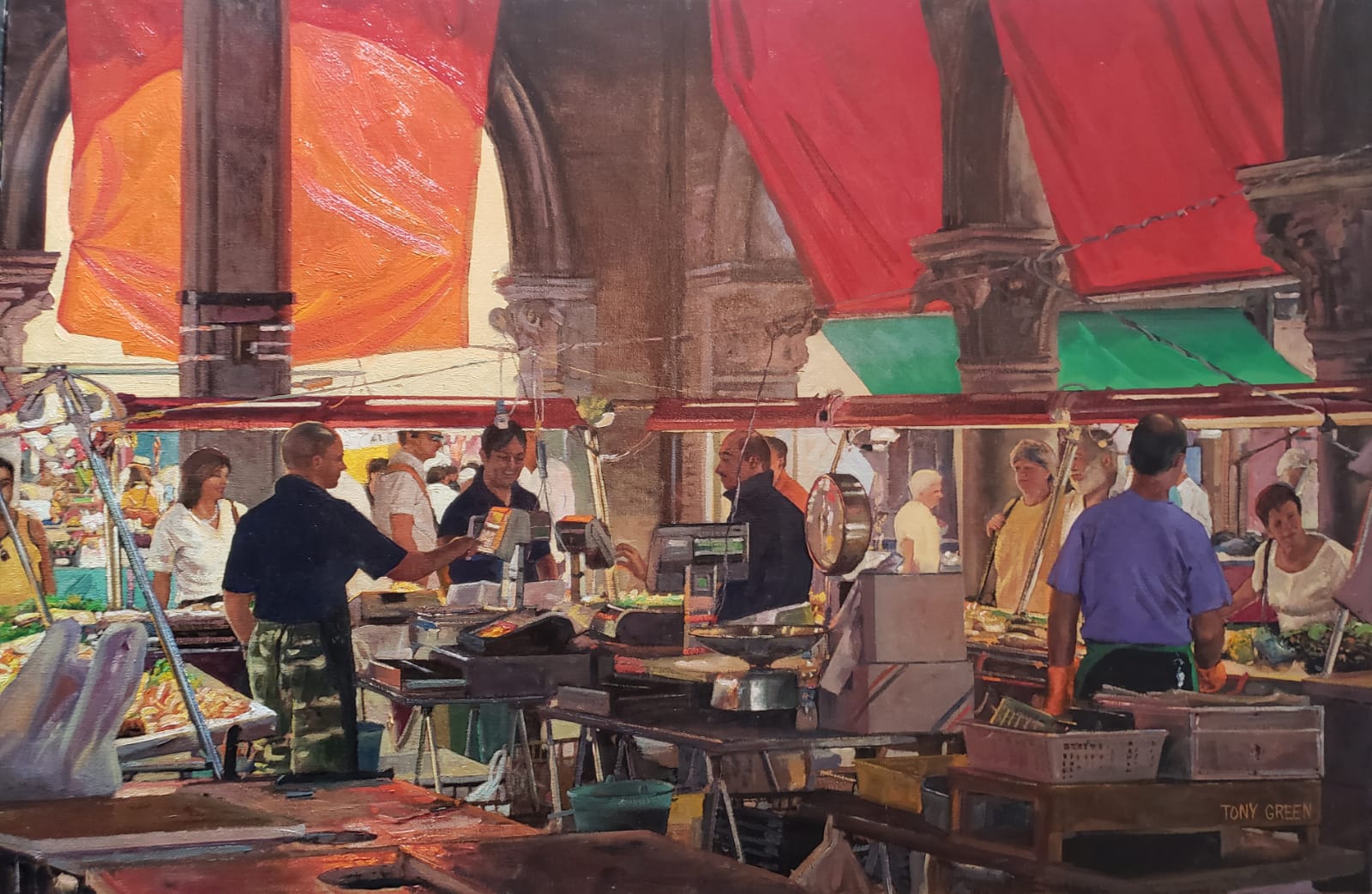
Ask for the exact conservation history in plain language: what was done, when, by whom, and whether any intervention changed the original surface. If a seller says the work has “been restored,” ask for the conservator’s invoice or report and a close image of the affected area. A small stable repair is one thing; an overcleaned varnish or aggressive retouching is another, especially when the price claims rarity or importance. When the work is by a living artist, a note from the studio about materials and intended display conditions can be useful, and Tony Green’s background makes that kind of method conversation especially relevant to collectors weighing longevity as well as appearance.
The practical test is simple: can the piece live where you want to place it without constant compromise? Before paying, compare the work’s medium, scale, and frame depth against the wall, glazing, and light available in the room.
Scale, placement, and how the work lives in the room
The real test begins where the wall meets the furniture. A work that looks elegant in a gallery can feel cramped above a sofa, float awkwardly over a console, or disappear in a long corridor. Measure the wall span, the furniture width below it, and the clear height from floor to hanging point before you commit. In Scottsdale homes, where strong light and open plans can make edges read harder, those numbers matter as much as the image itself.
Ask for the framed dimensions, not just the image size, and compare the frame depth to the room’s sightlines. A shallow frame may sit cleanly in a narrow passage; a deeper one can project beautifully in a larger room, but only if it does not crowd door swings or catch glare from nearby windows. If the work will hang near a window or opposite a glass door, confirm whether the surface is matte, varnished, or glazed, because that finish will decide how the piece reads at different hours.
Lighting is part of the purchase, not an afterthought. A painting under warm lamplight can feel intimate at night and flat in morning sun; a work with reflective glazing may lose its clarity entirely if it faces direct desert light. Before buying, ask for a photo of the piece in the kind of setting you intend to use, or place painter’s tape on the wall to mark the exact footprint. If the scale is close but not exact, a commission can solve the fit without forcing the room to adapt around the object.
When the dimensions are right, the room stops arguing with the work and starts supporting it. That is the point where a collector can move from comparing size and placement to considering whether the title, subject, and maker’s intent still align with the object in front of them; Tony Green’s background and available work make that conversation easier to have with specifics rather than guesswork.
A 90-second checklist before you buy
One fast comparison can save you from a costly mismatch: place the candidate beside a known reference in your mind, such as the scale of an overmantel, a stair landing, or the clear wall at eye level in a room you use daily. If you are standing in front of a work after a visit to O’Keeffe Mus. or after a stop at the FREE Admission at Western Spirit Celebrating Their $12 Million Expansion! listing, the better question is not whether you like the object, but whether you can name where it will live, what will support it, and whether the frame helps or fights the image. FREE Admission at Western Spirit Celebrating Their $12 gives you a public counterpoint here: it shows how much presentation can shape first impressions before the work has to stand on its own.
Before money changes hands, ask for the document set that lets the story and the object agree: invoice, provenance note, condition note, and a current image of the reverse. If the room is still uncertain, a commission conversation can solve the fit more cleanly than forcing a near miss; that is where Commission becomes useful, especially when the wall, the light, and the intended viewing distance all need to be coordinated.
Authenticity, comparison, and when the story outruns the object
Once the paperwork is in hand, the sharper test is whether the object can hold the same story without help. A work may come with a polished narrative, but if the signature style shifts under close viewing, the support feels wrong for the stated period, or the surface has been altered too aggressively, the claim weakens fast. In Scottsdale, where buyers often compare across galleries, private sales, and advisory channels, ask for one clean comparison point: a documented example by the same artist, same medium, and similar date. If the seller cannot show how this piece aligns with that reference, the story is doing more work than the object.
The sales story outruns the object when the language gets larger than the facts. “Museum quality” is easy to say; it means little unless the dimensions, condition, and provenance support the claim. A useful question is whether the same work would still make sense if the label were removed and only the image, support, and measurements remained. If the answer is yes, the piece is probably carrying its own weight. If the answer depends on a dramatic backstory, compare it with other available work in the shop or, for a room-specific fit, a focused commission conversation; that is usually where the next decision becomes clear.
How to use Scottsdale as context without outsourcing your judgment
Scottsdale can sharpen a buyer’s eye without becoming the authority. In a market where polished presentation is common, the useful question is not whether a piece looks expensive in a bright gallery, but whether it still holds together when you picture it in the room you actually have. That means comparing the work against your wall height, sightlines, and the amount of visual activity already in the space, rather than letting the local gallery atmosphere do the persuading for you.
When the room calls for something specific, custom is often the more honest route than forcing a near-fit into place. A commission conversation can settle scale, palette, and placement before the work is made, which is often the better answer for collectors who already know the wall but not yet the object. The practical test is simple: if the piece still makes sense after the sales language falls away, and you can explain why it belongs where you plan to live with it, you are ready for the next comparison.
Leave a Reply