
Late afternoon in a Santa Fe room can make a painting look finished before you’ve even stood in front of it. The light comes in low, catches the weave of a linen canvas, and throws a shadow along the edge of a frame that suddenly looks too thin, too ornate, or just right. A work that seemed modest online can claim a wall once you measure it against the sofa, the doorway, the ceiling height, and the quiet in the space around it.
That is the real problem this guide addresses: not whether a piece is attractive for a moment, but whether it will hold up as an object you live with and eventually want to keep. In Santa Fe, where collectors compare galleries, studios, and private holdings with a sharp eye, lasting value usually comes down to a few concrete checks—provenance you can verify, condition you can inspect, medium and support you understand, scale that fits the wall and the room, placement and lighting that won’t punish the surface, and authenticity that can be traced rather than assumed. Those are the details that separate a passing purchase from a work that still feels sound years later.
As the earlier notes on buying original work in Santa Fe suggest, the smartest next step is not to broaden the search, but to narrow the questions: what exactly is being sold, what has happened to it, where will it live, and what will you be able to prove if you ever need to. The sections ahead turn those questions into a practical checklist.
Table of Contents
- Evidence and paper trail: what to verify first
- Condition, medium, and conservation implications
- Scale, placement, and how the work lives in the room
- A 90-second checklist before you buy
- Authenticity, comparison, and when the story outruns the object
- How to use Santa Fe as context without outsourcing your judgment
Evidence and paper trail: what to verify first
The first thing to ask for is not a story, but the paper trail behind it: a signed invoice, a certificate of authenticity if one exists, prior sale records, exhibition history, and any condition notes tied to the work. A clean file does not guarantee value, but it tells you the object can be traced, and that matters more than a polished sales pitch when the asking price starts to climb.
If the documentation is thin, the decision changes immediately. An unsigned receipt, a vague title, or a chain of ownership that jumps from “private collection” to “estate” without names should push you toward a lower offer, a longer hold, or no purchase at all. In Santa Fe galleries, where serious buyers compare notes quickly, the difference between “documented” and “described” can be the difference between confidence and a future dispute.
Ask one concrete question: “Can you show me the work’s provenance from the artist forward?” Then compare the answer against the object itself—title, dimensions, medium, date, and any edition number should match across the paperwork and the label. If the seller can’t produce consistent measurements or the medium changes from one document to another, the story is already weakening.
For older work, a quick check against institutional or scholarly records can save you from buying a gap disguised as a history; the provenance tools at Getty Proven. are useful for seeing how careful that trail can be. When the evidence is solid, you can move on with more confidence to what the object is made of, how it has aged, and whether its condition supports the value being claimed.
Condition, medium, and conservation implications
A clean paper trail only gets you to the threshold. The real test is whether the object itself can support the price being asked. A Santa Fe buyer sees this clearly in the gallery light: a linen canvas may present beautifully from six feet away, but under closer inspection a lifted corner, old inpainting, or a brittle varnish can change both the risk and the value. Ask for the condition report, then compare it to the work in hand: where are the repairs, what was stabilized, and has any restoration altered the surface texture or the artist’s original handling?
Medium matters because different materials age in different ways. Oil on panel, for example, can remain remarkably crisp but may show panel movement or edge wear; oil on canvas can be stable yet vulnerable to slackening, denting, or past relining; works on paper ask a different set of questions entirely, from foxing to mat burn to light sensitivity. If the seller says “excellent condition,” ask for the measurement of every noted issue and a close image of each one, ideally with scale. That lets you compare condition against the same class of work rather than against a vague promise.
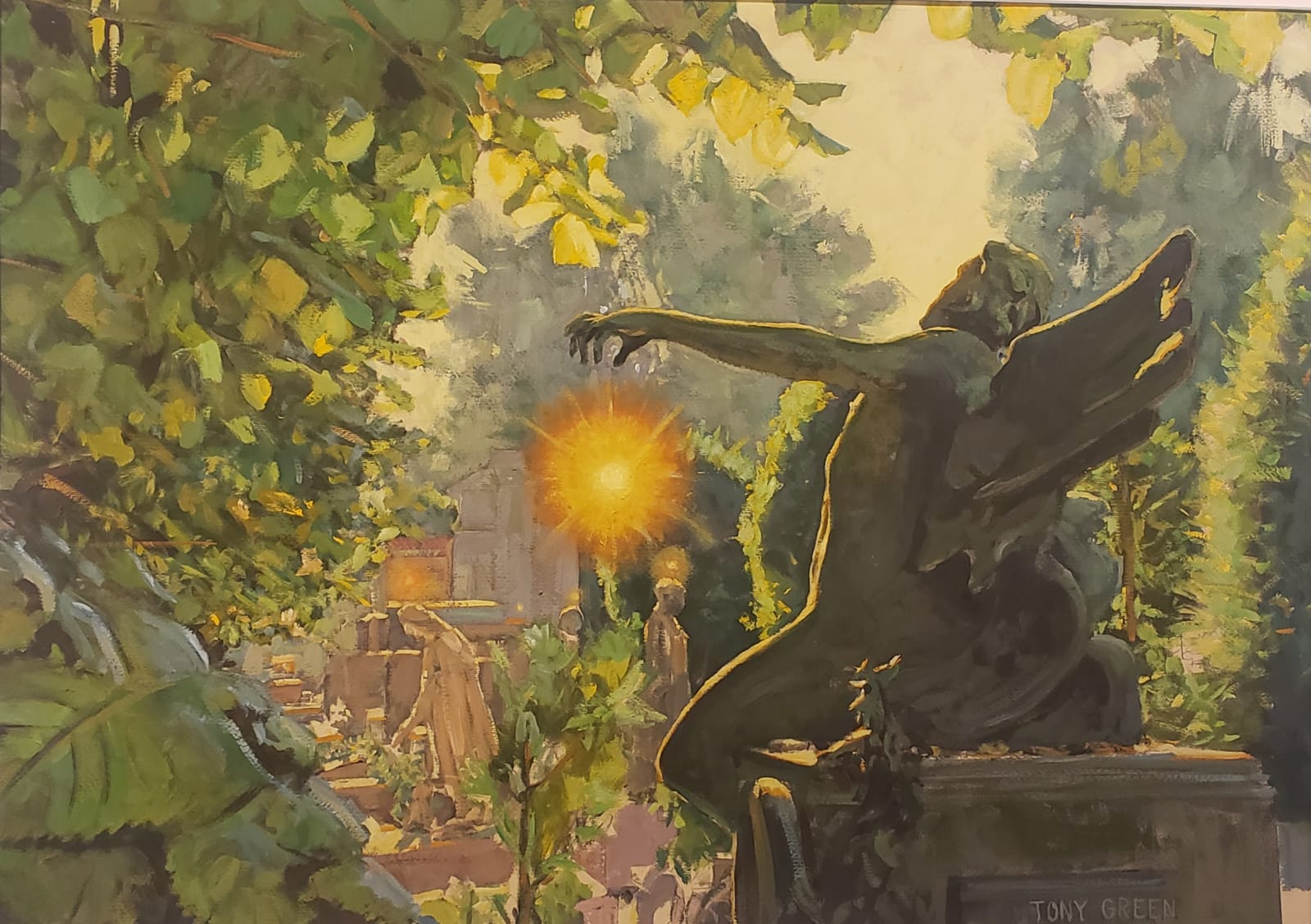
This is where the commercial judgment becomes practical. A painting with strong provenance and modest restoration may still be a sound purchase if the intervention is documented and consistent with the medium. A piece with a dramatic story but unclear conservation history is harder to defend later, especially if you plan to insure it, loan it, or place it in strong light. Tony Green’s work, for example, is built with classical methods that reward scrutiny of support, ground, and finish; if you want to compare available work by scale and medium, the shop gives you a useful reference point, while a room-specific commission can be discussed through commission when placement and conservation concerns need to be resolved together.
Before you pay, ask three direct questions: Has the work been cleaned, lined, relined, or re-stretched; what exactly was original versus restored; and can the seller supply the dimensions of the image, the support, and the framed object separately? Those numbers matter in Santa Fe, where wall scale, light, and climate can expose weak spots quickly. Once the material facts are clear, the next step is to test whether the piece can physically live in the intended room.
Scale, placement, and how the work lives in the room
Those numbers matter because a painting that reads well in a booth can go strangely flat over a sofa or feel overpowering in a narrow hall. In Santa Fe, where rooms often carry strong light, thick plaster, and deep shadows, the first question is not whether the work is beautiful but whether its size, frame depth, and visual weight can hold a wall without crowding the furniture around it. Ask for the image dimensions, the framed dimensions, and the wall space you actually have, then compare them to the sightline from the doorway and the main seating position.
Framing changes the buying decision more than many collectors expect. A narrow gilded profile can sharpen a classical painting and make it read cleanly in a low-lit room; a heavy, dark frame can pull the eye inward and make a smaller work feel compressed. If you are looking at a piece on Tony Green’s shop, check whether the listed size is the painted surface or the full framed object, and if the work is unframed, ask what frame treatment the artist intended. A work with a generous border may need breathing room, while a tightly cropped image can sit closer to other objects without losing force.
Placement is also a lighting decision. Direct sun can wash out subtle glazes, but a dim corner can flatten the edges and mute the structure of the paint. Stand where the work would hang and notice what time of day the wall actually receives light; in a room with strong afternoon sun, ask whether the finish and varnish will hold their depth without glare. If the piece is meant for a specific wall or a difficult alcove, a room-specific conversation through commission can solve proportion and lighting at once, especially when the support, scale, and framing need to be planned together.
Pro tip: Measure the wall, the furniture below it, and the viewing distance before you buy. Then ask for a photo of the work mocked up at approximate scale, plus the framed and unframed dimensions, so you can see whether it will read as a focal point or a visual afterthought.
- Compare the image size to the frame width, not just the title listing.
- Check
A 90-second checklist before you buy
Framing deserves the same discipline. Ask what is included, what the frame is made of, and whether the glazing or backing changes the depth of the piece enough to affect hanging hardware. A work can be beautiful and still land badly if the frame is too heavy for the wall or too shallow for the lighting. When you are checking how to choose art that lasts in Santa Fe, this is the point where the object either feels settled or starts asking for compromise.
If the story, object, and room still agree after that check, you are close. A quick conversation about authenticity, provenance, and whether the wall can physically support the piece is enough to separate a promising purchase from a decorative mistake; that is why a reading like the Santa Fe Literary Review Annual Reading can be a useful reminder that presentation shapes perception, even before you step into the gallery. If the fit still feels unresolved, a room-specific commission is the cleaner next move than forcing the wrong scale into place.
Authenticity, comparison, and when the story outruns the object
A good comparison set helps strip away romance. Look at two or three credible examples of the same medium or period and ask what is genuinely consistent: palette, handling, edge treatment, framing, and price relative to size. If a seller says the piece belongs to a particular body of work, the closest parallel should not only resemble it visually but also share the same materials and format. When the comparison breaks, the story is doing more work than the object.
When the object and the story agree, the next question is fit: not just whether it will hang, but whether it will belong. A work that is honest in provenance and exact in measurements can still be wrong for the wall if the framing, light, or visual weight fights the room. If you already know the piece needs a different proportion or a custom approach, a Commission discussion is usually the more disciplined path. That is the point where Santa Fe stops being a backdrop and becomes a sharper lens for judgment.
How to use Santa Fe as context without outsourcing your judgment
In Santa Fe, the room is never just a room. Adobe walls, strong daylight, and gallery-honed expectations can make a painting look more resolved than it is, or expose a weakness that a softer setting would hide. That is useful pressure, but only if you treat it as context instead of verdict. A work that feels calm under high, clean light still has to hold up when you ask the harder question: does it keep its presence when the sales language falls away?
One concrete test is simple: ask for the exact dimensions, then mark them out on the wall with painter’s tape and stand where you will actually live with it. In Santa Fe, where collectors often care about a piece’s dialogue with architecture as much as its surface, that taped rectangle can tell you more than a polished listing. If the work is intended for a specific niche, stair landing, or sunlit wall, a room-specific conversation through Commission is often the cleaner move than forcing a near-fit into the wrong place. The decision that matters now is whether the piece still feels inevitable when you remove the surrounding noise.
STUDY FOR THE NEW WORLD ORDER
Leave a Reply